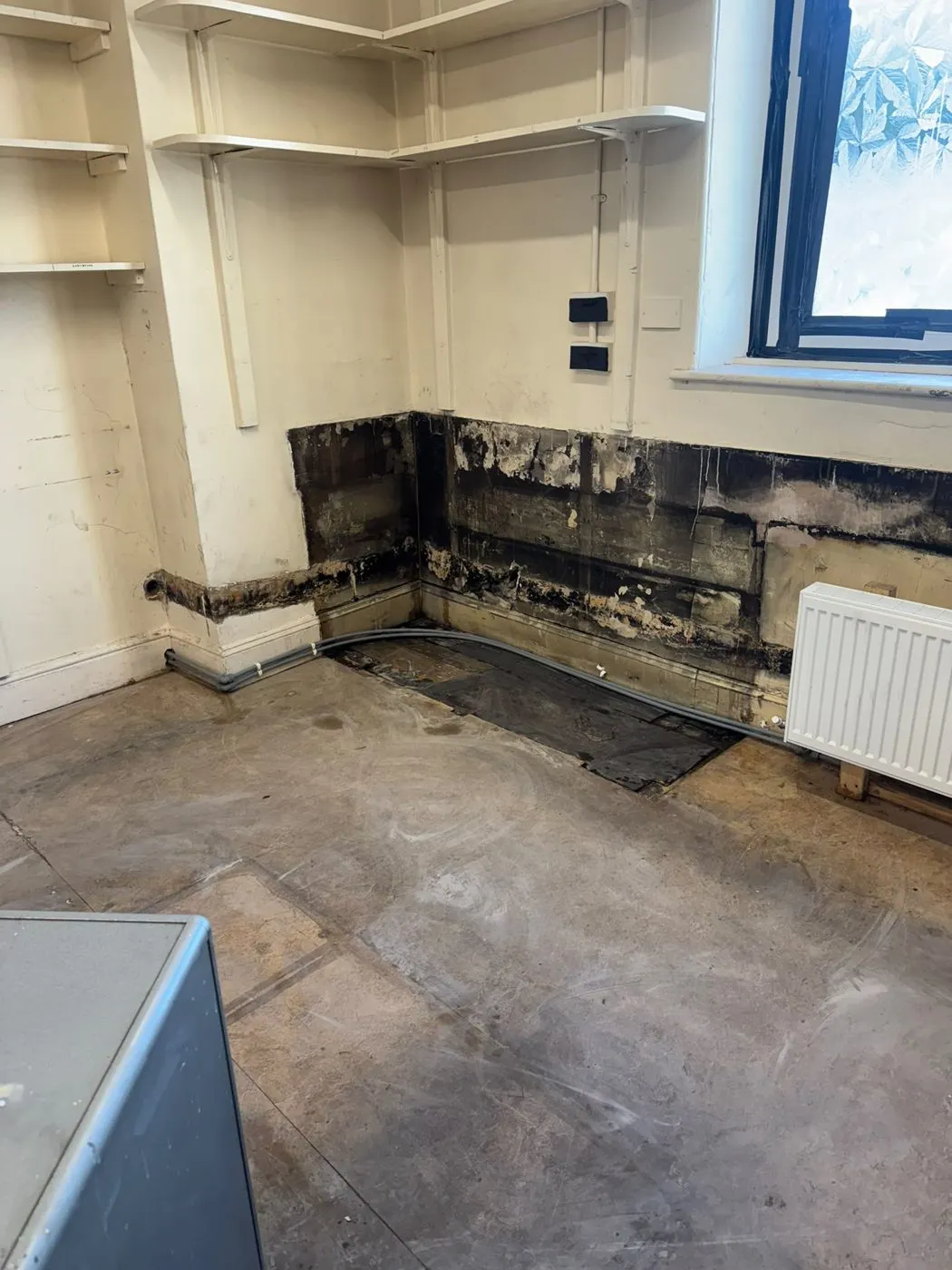
Croft House on South Street is a working commercial laboratory, and Keighley Laboratories were refurbishing it in phases. Their refurbishment survey had flagged the first-floor store and the staircase beside it as restricted access: loose insulating board debris on the store floor, amosite lagging on the pipework, and AIB panels to the staircase walls, bulkhead and door header next to the Instrument Room.
We split the job into two phases. Phase 1 was an urgent non-licensed make-safe — an environmental clean of the loose AIB debris on the store floor and the ledge above the staircase door, with personal and reassurance air monitoring carried out by an independent UKAS-accredited analyst (personal 0.029 f/ml, reassurance below 0.010 f/ml) before the areas were released back to the client.
Phase 2, the subject of this page, was the licensed removal of everything that remained: around 8 linear metres of thermal insulation lagging to the pipework, 6m² of lagging debris inside the floor cupboards, a 1.5m² AIB door panel in the store, 4m² of AIB wall panels and bulkhead to the staircase, and a 1m² AIB door header above the Instrument Room door. Twenty square metres in total, notified to the HSE fourteen days in advance, and completed inside a single sealed, negatively pressurised enclosure covering both the store and the staircase.
The laboratory stayed open throughout.
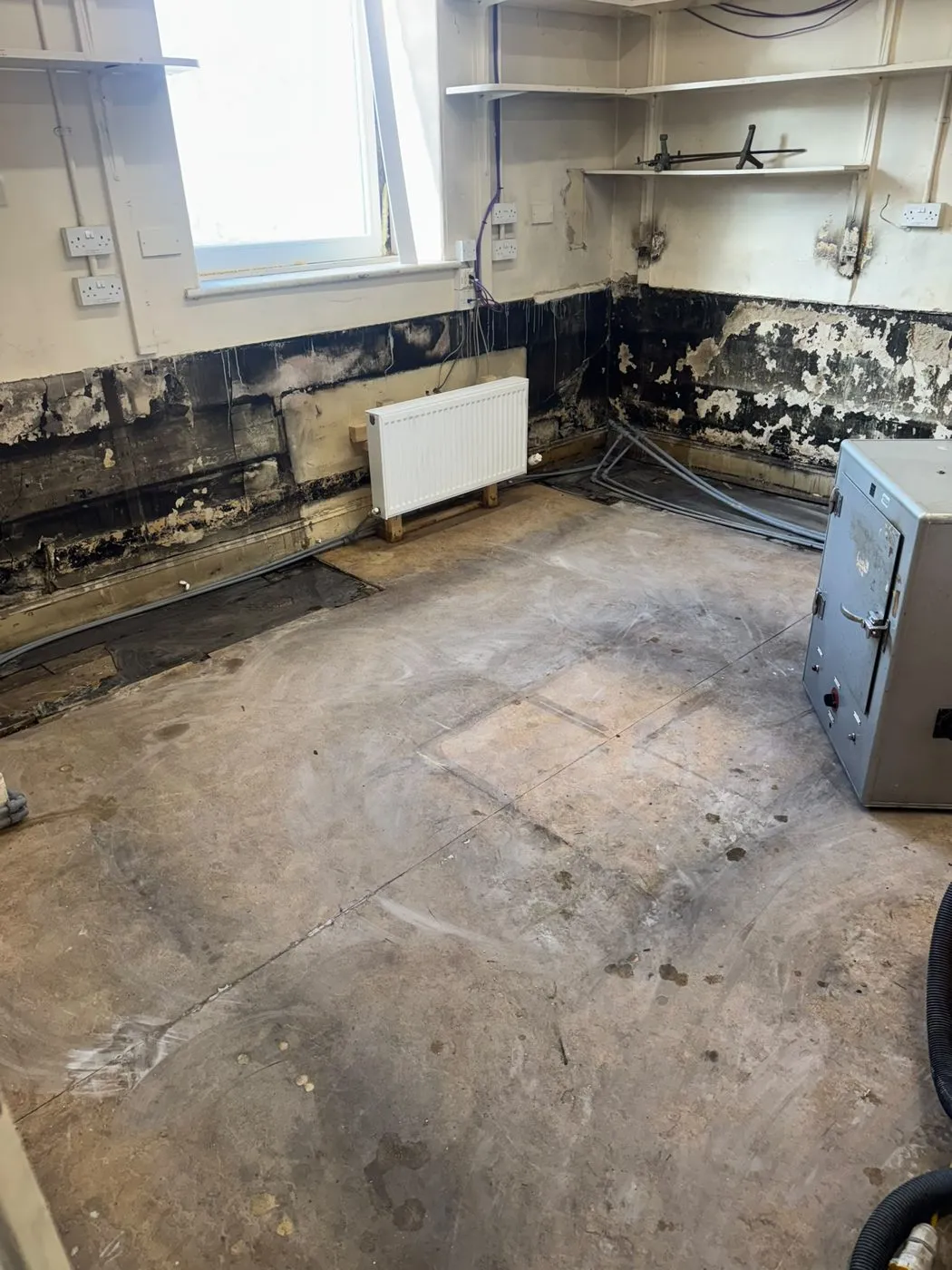
The survey by Acorn Analytical Services identified the materials and sample references before we arrived, so there was no guesswork about what was in the room. The store held lagging on the pipework and a door panel; the staircase carried the AIB wall panels, a bulkhead and a door header. Materials were generally in fair condition, with localised heavy damage to the lagging and residual debris in the cupboards — which is why the debris clean came first, as a separate phase, before the licensed work began.
Because a working laboratory sat on either side of the enclosure, the plan of work was written around the client’s operations as much as around the asbestos. Alternative first-floor access was agreed with Keighley Laboratories before the staircase was sealed, client staff access to the affected areas was prohibited for the duration, and waste runs were timed to agreed low-traffic periods so the transit route through the building did not interfere with laboratory work.
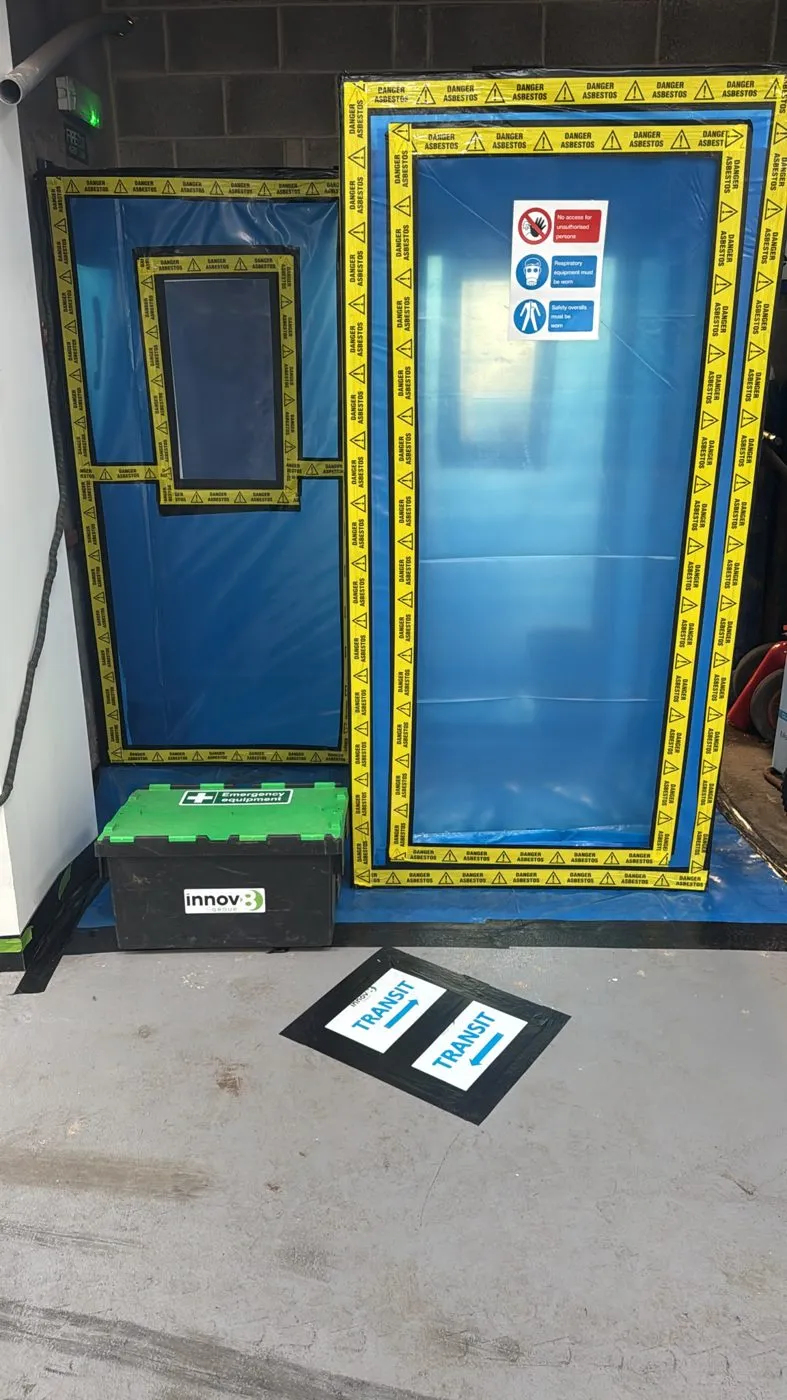
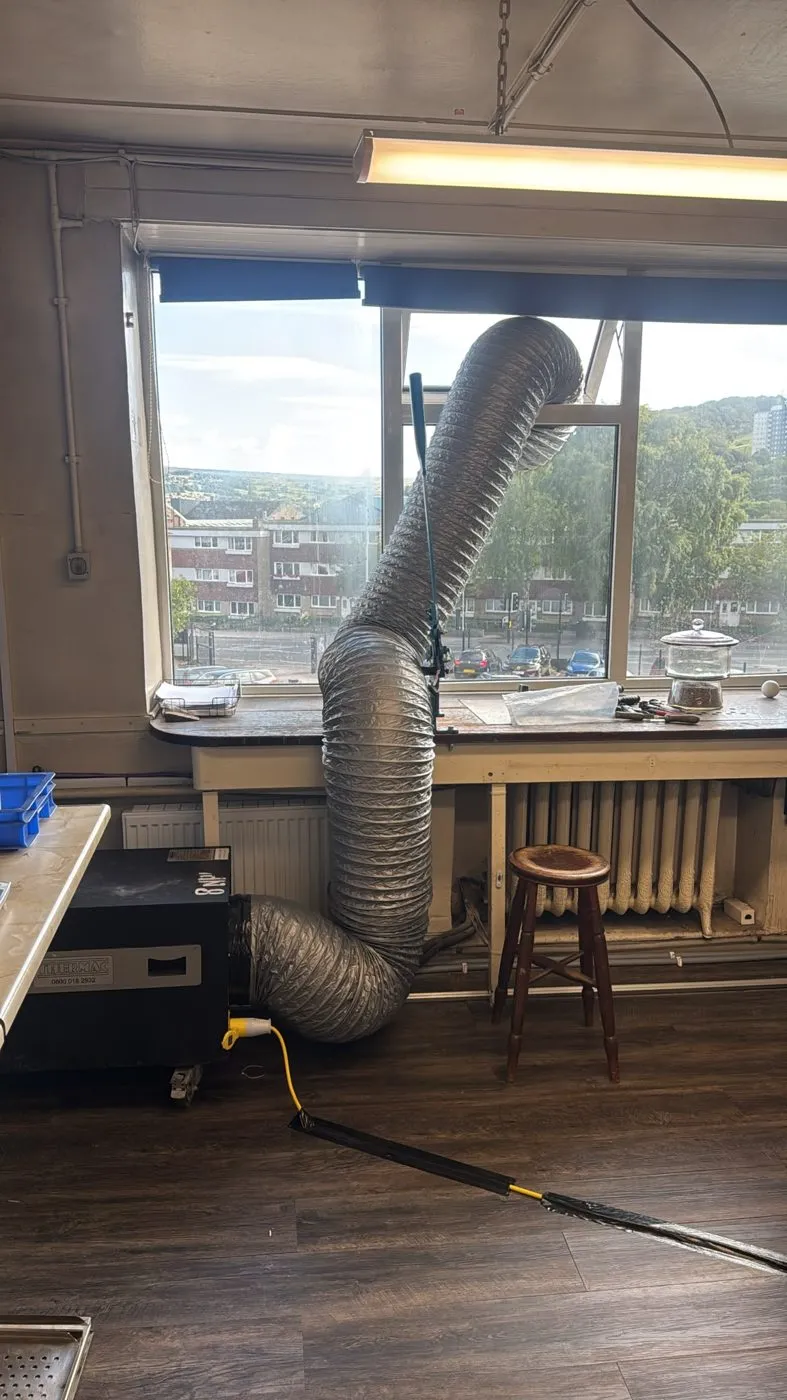
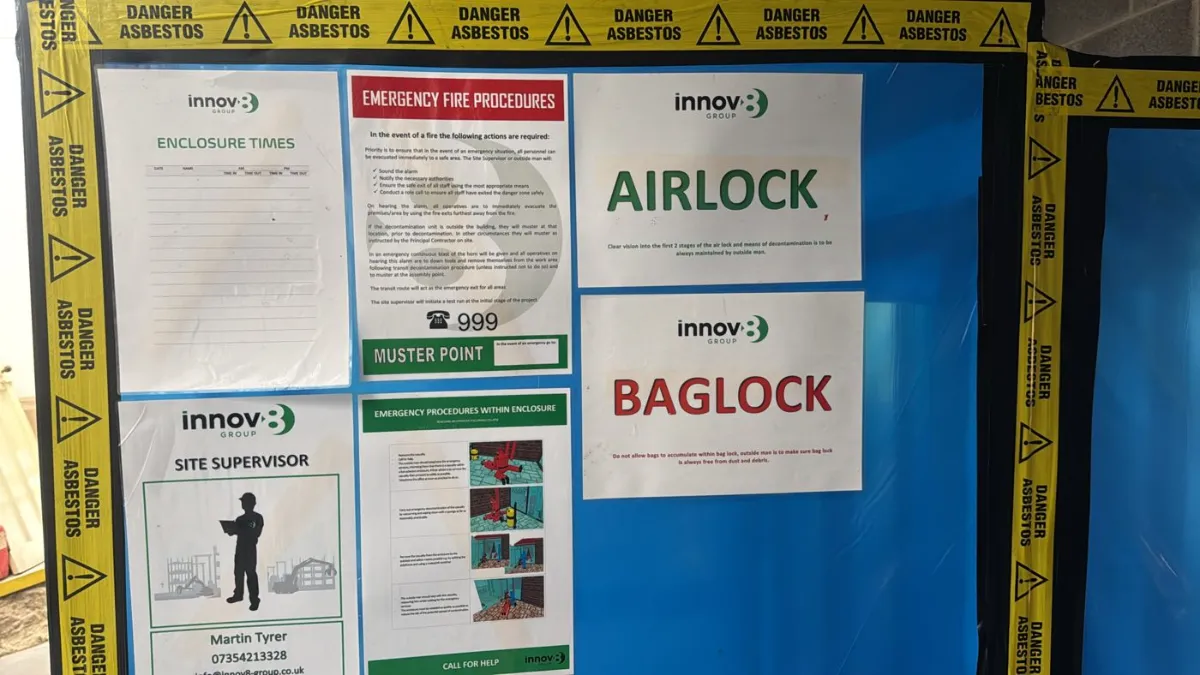
The whole area was enclosed under one fully sealed, negatively pressurised enclosure with a three-stage airlock and a separate baglock. The negative pressure unit exhausted externally through a first-floor window via sealed ducting, with a second unit on site as standby. The enclosure was smoke-tested for integrity before any removal started, and the NPU manometer was checked and recorded every day.
The pipework lagging was removed first by BS 8520 controlled wet injection — a wetting agent injected through the outer finish at regular centres along the full 8 metres until the insulation was saturated through its full thickness, confirmed by the supervisor before a single section was disturbed. Damaged sections were pre-wetted and locally sealed ahead of injection. Only once the lagging was out did the team move to the debris in the cupboards, and then to the AIB panels, which were removed whole rather than broken, with shadow vacuuming throughout.
All air monitoring — background, leak, reassurance and clearance — was carried out by an independent UKAS-accredited analyst, with the four-stage clearance to HSG248 on the final day. Anticipated exposure inside the enclosure was set at 0.03 f/cm³ against the control limit of 0.1, based on our own personal monitoring records from comparable AIB jobs.
Beyond the asbestos, the staircase itself was the main hazard: work at height on stairs, with all materials at safe working height reached from stepladders and a stair-legged podium rather than a tower. The pipework was drained down and electrically isolated before wet injection. Manual handling of the AIB panels down the internal stairs and along a 50-metre transit route to the waste vehicle was planned as a two-person lift. Heat inside a sealed enclosure in September meant managed work and rest cycles, and daily supervision throughout.