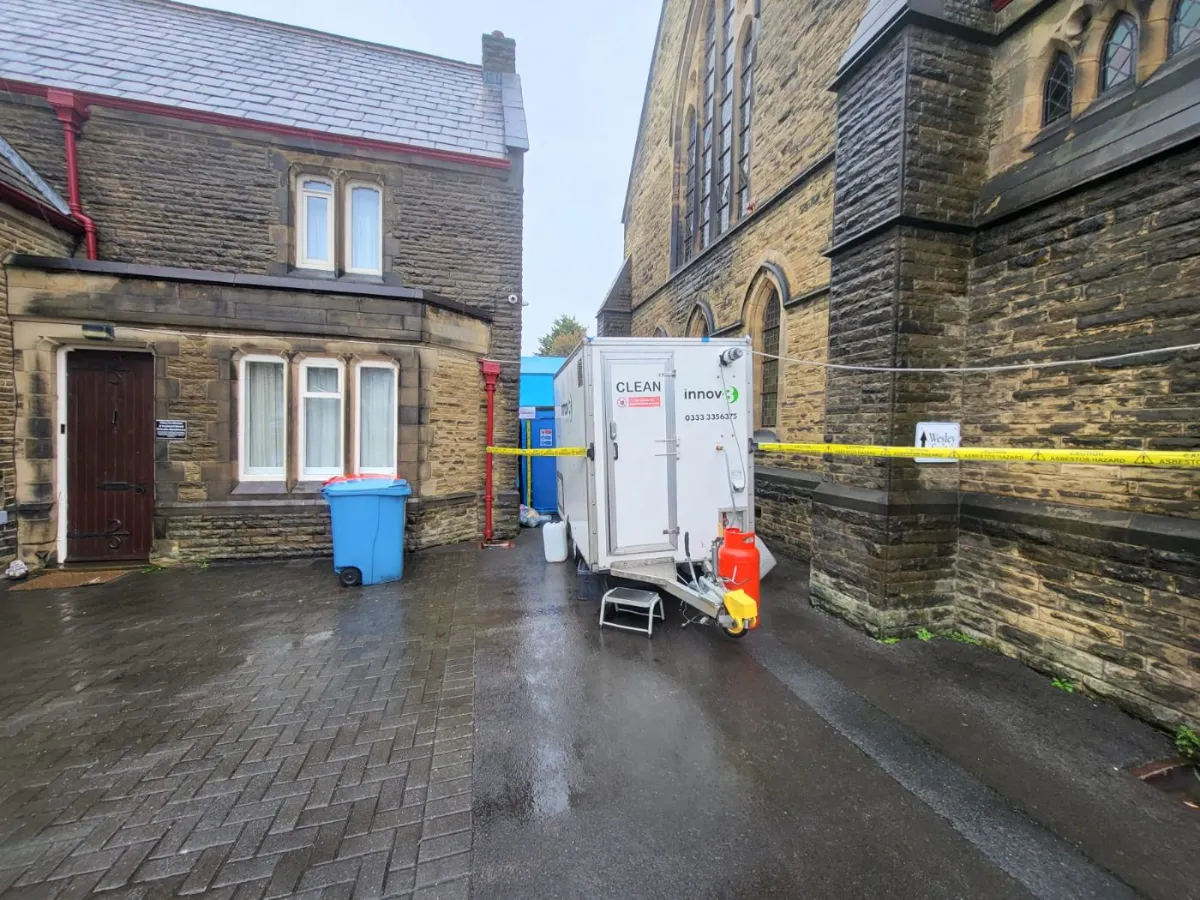
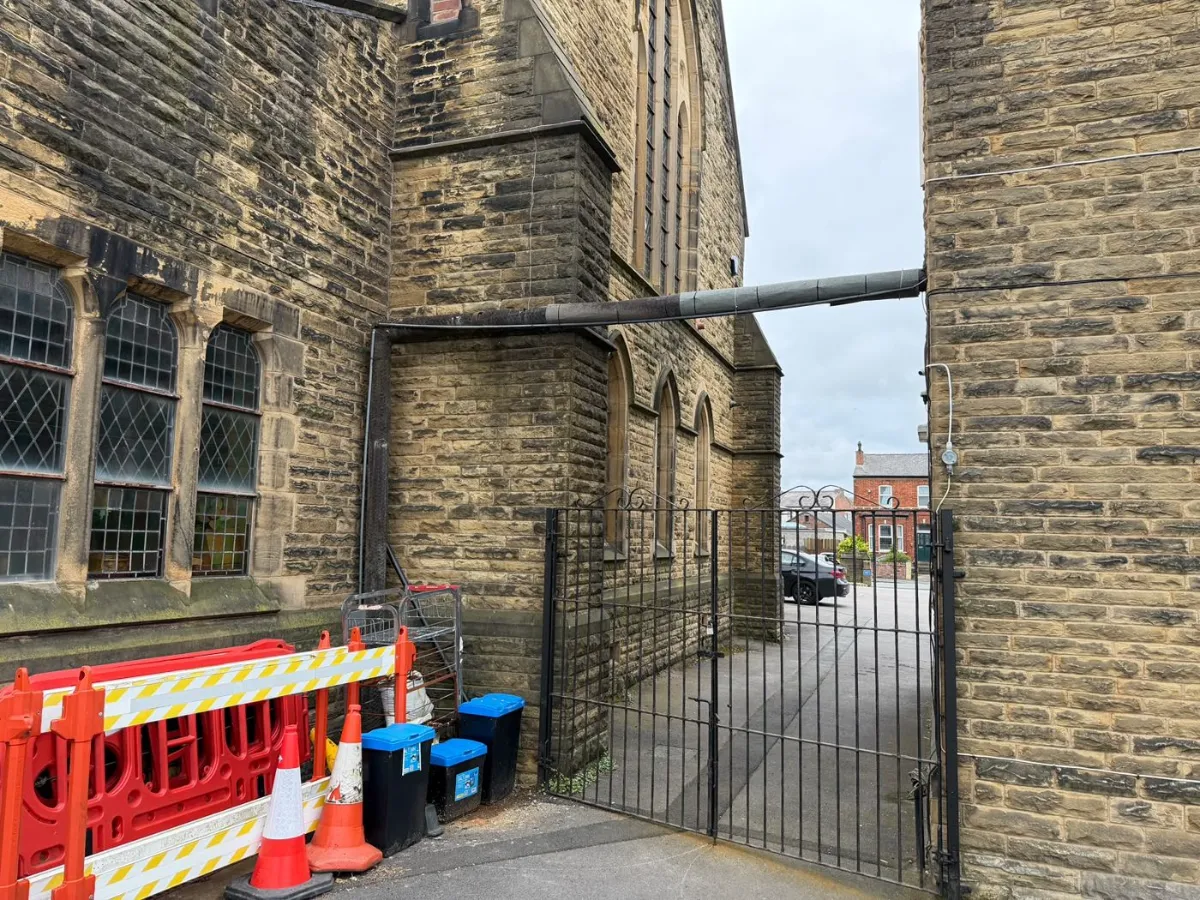
Between the main church and the adjoining building at Leyland Road runs a narrow stone alleyway, open to the sky, leading through to the car park. At high level across that alley ran six metres of old lagged pipework — amosite and chrysotile thermal insulation, delaminating and shedding debris onto the paving, the salt bins and everything stored underneath. The survey had scored it 11, high risk, with a recommendation to prohibit access pending planned works.
The church did not want to close. Services, hall bookings and the car park all carried on for the duration.
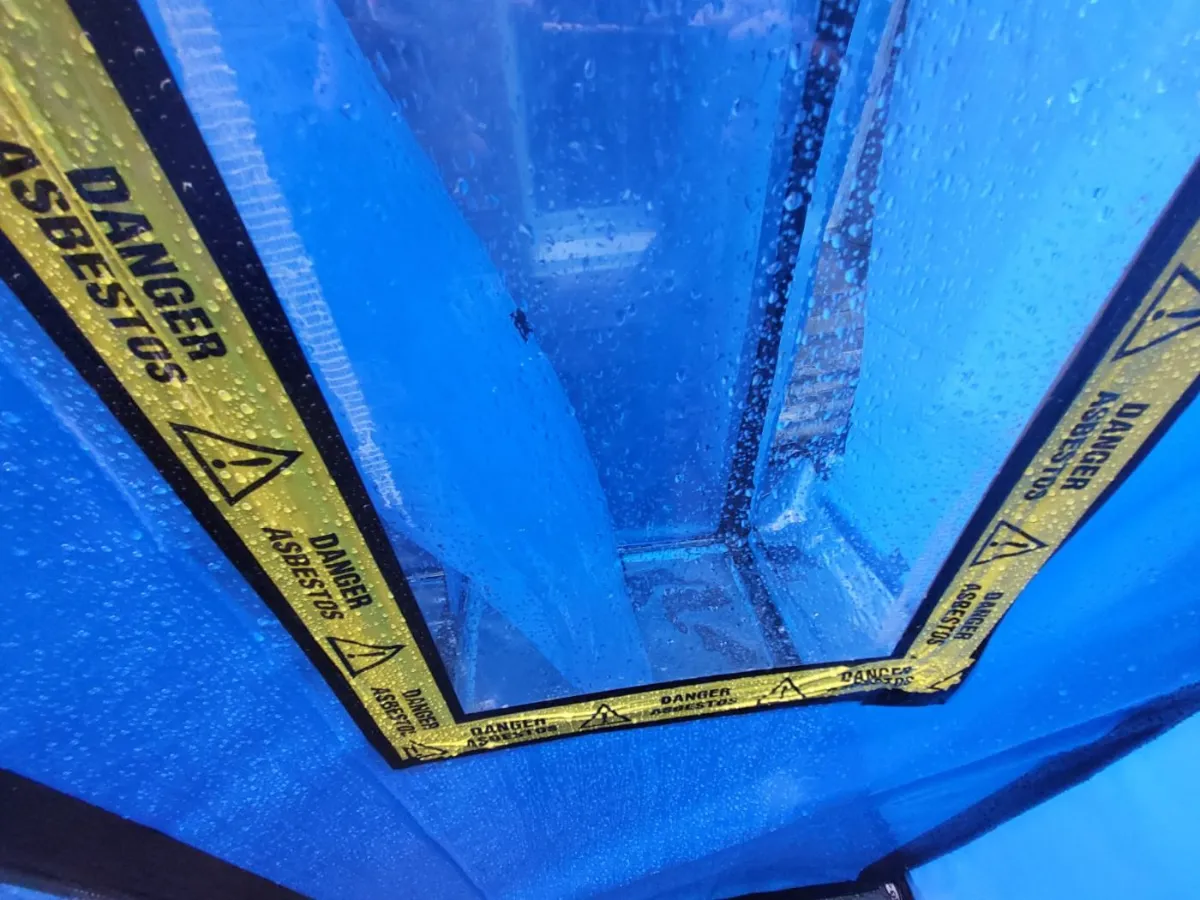
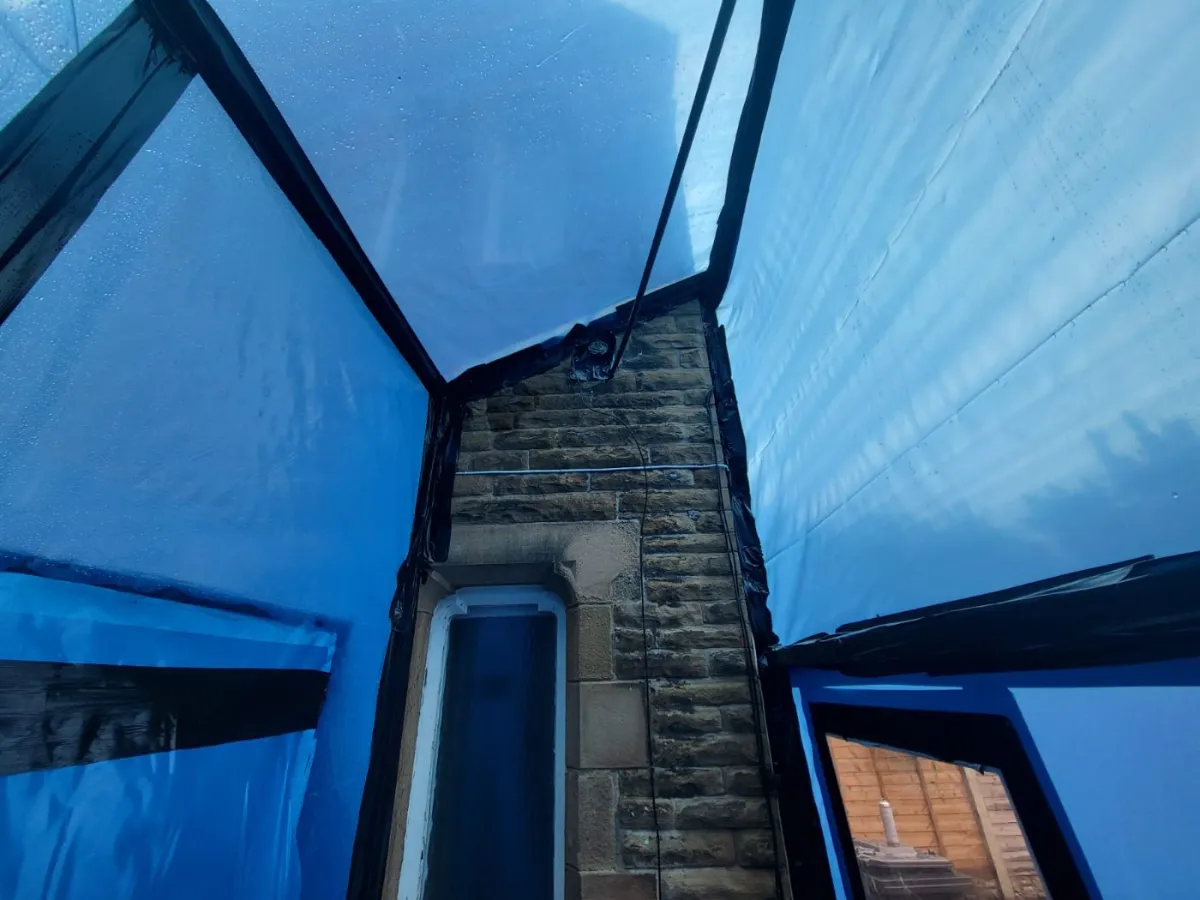
We dealt with it in two stages. First, an emergency make-safe and environmental clean of the debris under a separate job, so the alley could be used again while the licensed work was planned and notified. Then this project: a licensed, two-day removal of the lagging and the pipework itself, in a fully framed external enclosure built in the alley and braced against the wind, with a four-stage clearance by an independent analyst before it came down.
The lagged pipe was redundant, so rather than strip the insulation off it in place we removed it as pipework: inject and saturate the lagging, wrap each two-metre section, cut through bare metal, and lower the wrapped section under control to the second operative on the ground. This is the wrap-and-cut method, and it keeps the insulation intact inside its wrapping instead of releasing it into the enclosure. The largest single section weighed around 25 kg and was lowered, never dropped, with an exclusion zone beneath.
Because the run sits at high level, every step was carried out from a MiTower — a 3.2-metre PASMA-built platform, repositioned along the run rather than over-reached, and inspected by the supervisor before the analyst used it for clearance. The alley’s width and the fall of the paving were measured at the pre-start visit to confirm the tower could stand level.
The hold point before any of this was written confirmation from the church that the pipework was redundant, drained and disconnected at both ends. No confirmation, no enclosure.
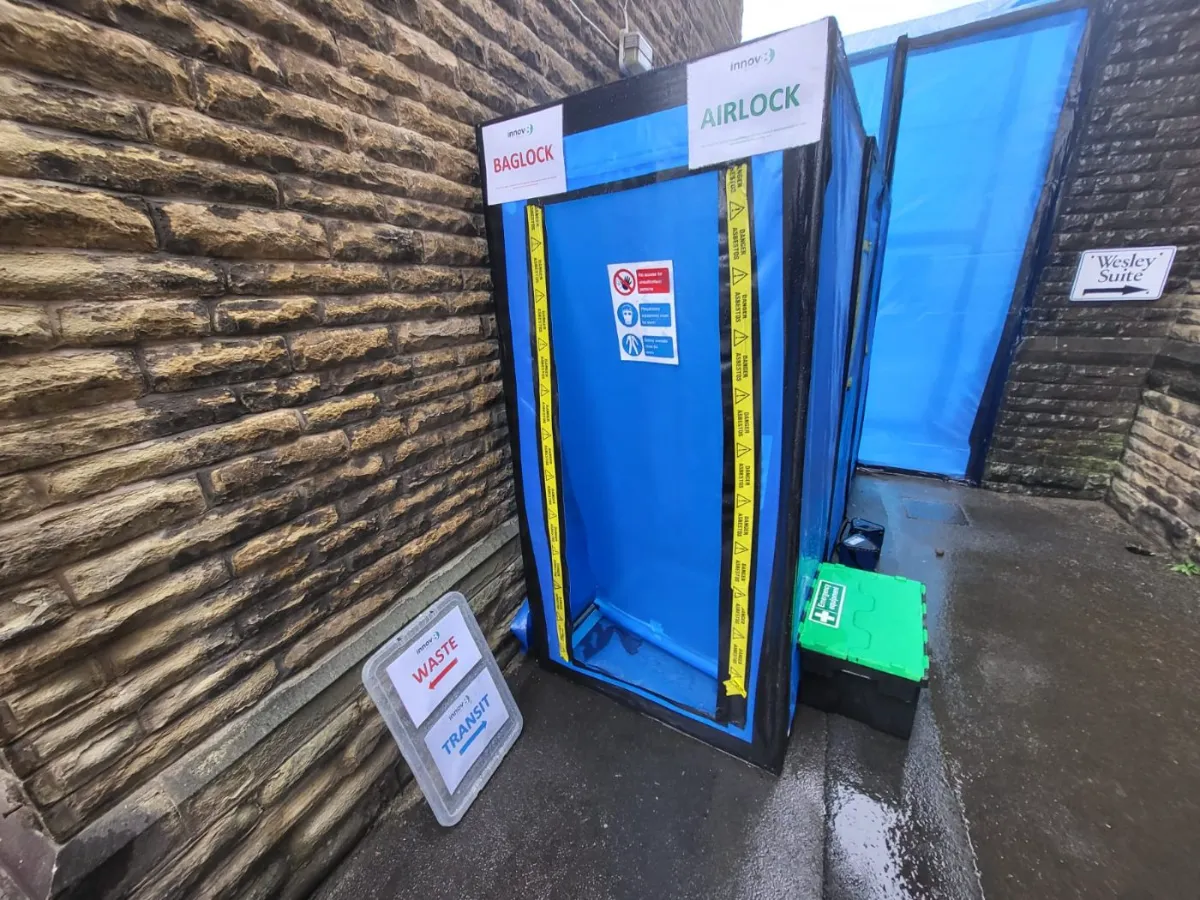
An external enclosure is a different job from an internal one. This one was a framed, sheeted enclosure built within the stone walls of the alley, closed at both ends, weighted and braced against wind, with the negative pressure unit discharging to open air. The forecast for the notified week included gusts to 74 km/h on day two, so the sheeting and fixings were inspected at the start of every shift, after every break and after any period of strong wind, and the transit route sheeting was taped and weighted so it could not lift.
The four-stage clearance to HSG248 was the air monitoring on this job — the enclosure is outdoors, so the conditions that make leak testing meaningful do not apply. Personal exposure inside was set from our own monitoring records for comparable wrap-and-cut lagging removals. Decontamination unit inside a Heras-fenced compound at the car-park end of the alley, fed from the church’s mains; the enclosure, DCU and waste compartment locked whenever unattended, and the car park gate locked overnight by arrangement with the church.
The alley is overlooked on both sides — hall windows at ground and high level on one side, a neighbouring house on the other — and the distance to the nearest occupied window was measured at the pre-start visit, with neighbours informed by the church before we mobilised. The alley was closed at both ends with fencing and signage, and the outside man marshalled anyone passing to the car park; nobody passed during a waste run or while the airlock was open.
Work at height, manual handling of 25 kg wrapped sections from a platform, a narrow overshadowed working area needing task lighting, and wet-strip run-off — which is asbestos waste and was contained and disposed of as such. The final clean ran top down: sheeting and frame, then the wall face and brackets, then the tower, then the ground beneath the run. The stone walls are rough and porous, so the pointing was vacuumed and wet-wiped as well as the faces.