

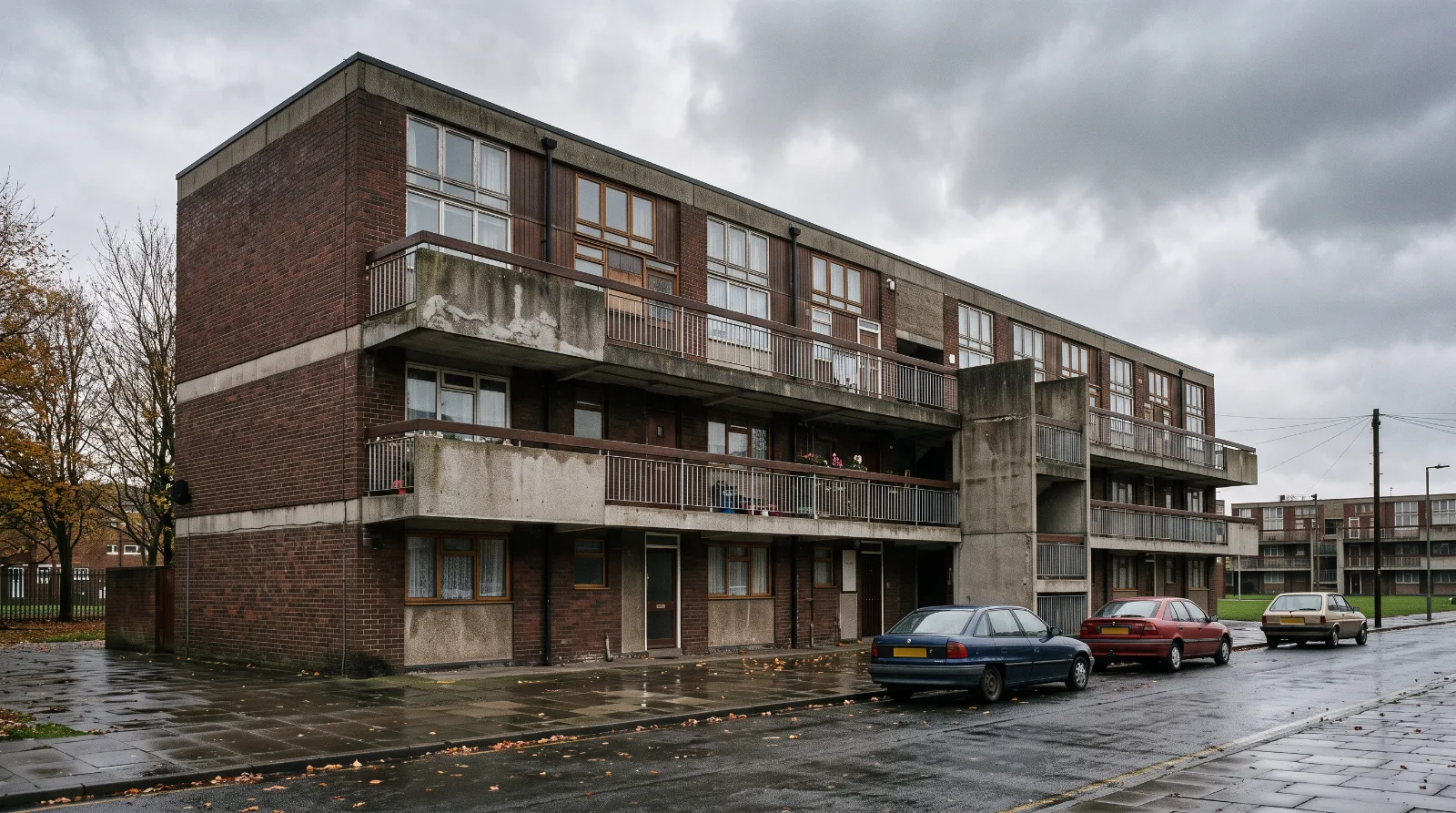
From 30 November 2026, Awaab’s Law moves into its second phase. Phase 1 covered damp, mould and emergency hazards. Phase 2 adds seven more: excess cold, excess heat, falls, fire, electrical hazards, domestic hygiene, pests and refuse, and structural collapse and falling elements. Each one comes with a legal clock — a timescale to investigate, a timescale to make safe, and written notice to the tenant.
Asbestos is not on that list. We want to be straight about that, because a few suppliers are already selling asbestos work on the back of Awaab’s Law. It is not in the new hazard categories.
What it does do is change the pace of everything else, and that is where asbestos comes in. Phase 2 puts landlords under a statutory clock for repairs in exactly the kinds of properties where asbestos is most common: pre-1980 stock with textured coatings on the ceilings, insulating board around the boiler cupboard, and vinyl floor tiles under the lino. An electrical hazard that has to be made safe in days means someone is going into a consumer unit — and pre-1970s fuse boards often sit on an asbestos-containing panel. Excess cold means heating repairs, and heating repairs mean pipework, and pipework in a 1960s block can still be lagged.
So the clock starts on the hazard, but the asbestos duty does not move. Regulation 4 of the Control of Asbestos Regulations 2012 still requires you to know what is in the building, to hold that information in a register a repairs operative can actually read, and to keep a management plan under review. The HSE’s own inspection campaign this year was looking for precisely three failures: no management plan, no training, and no procedure for work that could disturb asbestos.
What this means in practice
The pressure point is the gap between your repairs timescale and your asbestos information. If a Phase 2 hazard has to be resolved in a fixed number of days, and your operative cannot find out within an hour whether the ceiling they are about to drill contains asbestos, one of those two duties is going to give.
Three things are worth checking before 30 November:
- Can a repairs operative get the asbestos register on their phone, on site, in under a minute? Not the office copy. The site copy.
- Does your Phase 2 triage process include an asbestos check? A hazard raised under Awaab’s Law should trigger a register look-up as part of triage, not after the operative has arrived.
- Is the register actually current? A survey from 2015, with three refurbishments since, is not a register. It is a historical document.
Where we come in
We hold a full three-year HSE licence and work across social housing in the North West and Yorkshire, including occupied properties with tenants in place. Where a Phase 2 repair runs into asbestos, we can usually get to site, take samples, get a UKAS-accredited result and clear the way inside the repairs window rather than blowing it.
If your register is the part that worries you, that is a CAR 2012 compliance audit and it is a fixed-price piece of work.