info@innov8-group.co.uk Ring us: 0333 335 6375
Not sure which service you need? Ask us
REQUEST A CALL BACK
innov8 Group
01About 02Services 03Costs 04Projects 05News 06Locations 07Contact INSTANT QUOTE
GUIDES · CONTAMINATED LAND

Heavy Metals in Soil and Industrial Made Ground.

Former industrial sites and imported fill can contain metals associated with historic manufacturing, waste disposal or combustion residues. Soil testing and assessment establish whether those substances present a relevant risk and what needs to happen before the ground is developed or moved.
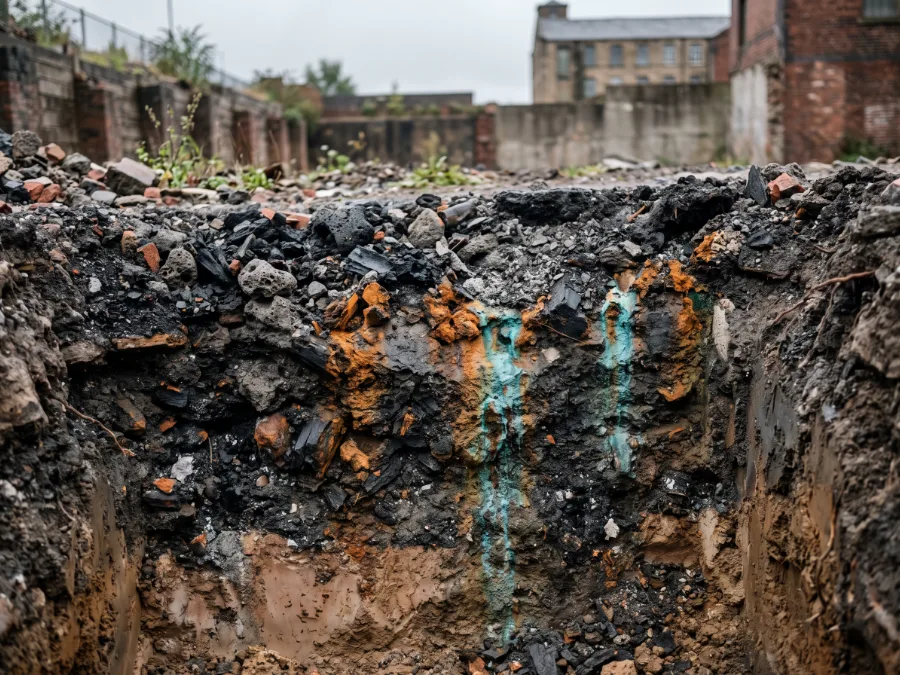
Layer of clinker, slag and ash with orange-brown and blue-green discolouration in an excavation wall

Why investigate metals in made ground?

Made ground may include ash, clinker, slag, demolition rubble and other deposited material. Its composition can vary sharply across a site and between layers. The presence of industrial debris is a reason to review the site's history; it is not proof that every deposit is hazardous or unsuitable for its intended use.

Can staining identify heavy-metal contamination?

No. Orange, brown, blue-green or other discolouration may be recorded during an investigation, but colour does not establish a particular metal or a harmful concentration. Some affected soils may show no obvious staining. Decisions need appropriate analytical evidence and interpretation.

What should soil testing cover?

The sampling plan should reflect the historical activities, ground conditions and likely distribution of contamination. A laboratory suite may include metals such as lead, cadmium, chromium, copper, nickel and zinc, together with other relevant substances. Arsenic, a metalloid, is also commonly considered in contaminated-land assessments.
Selecting tests is a technical decision, not a checklist to apply identically to every site. Different layers or deposits may need separate characterisation. The investigator should consider other potential contaminants too, including asbestos in made ground and petroleum hydrocarbons.

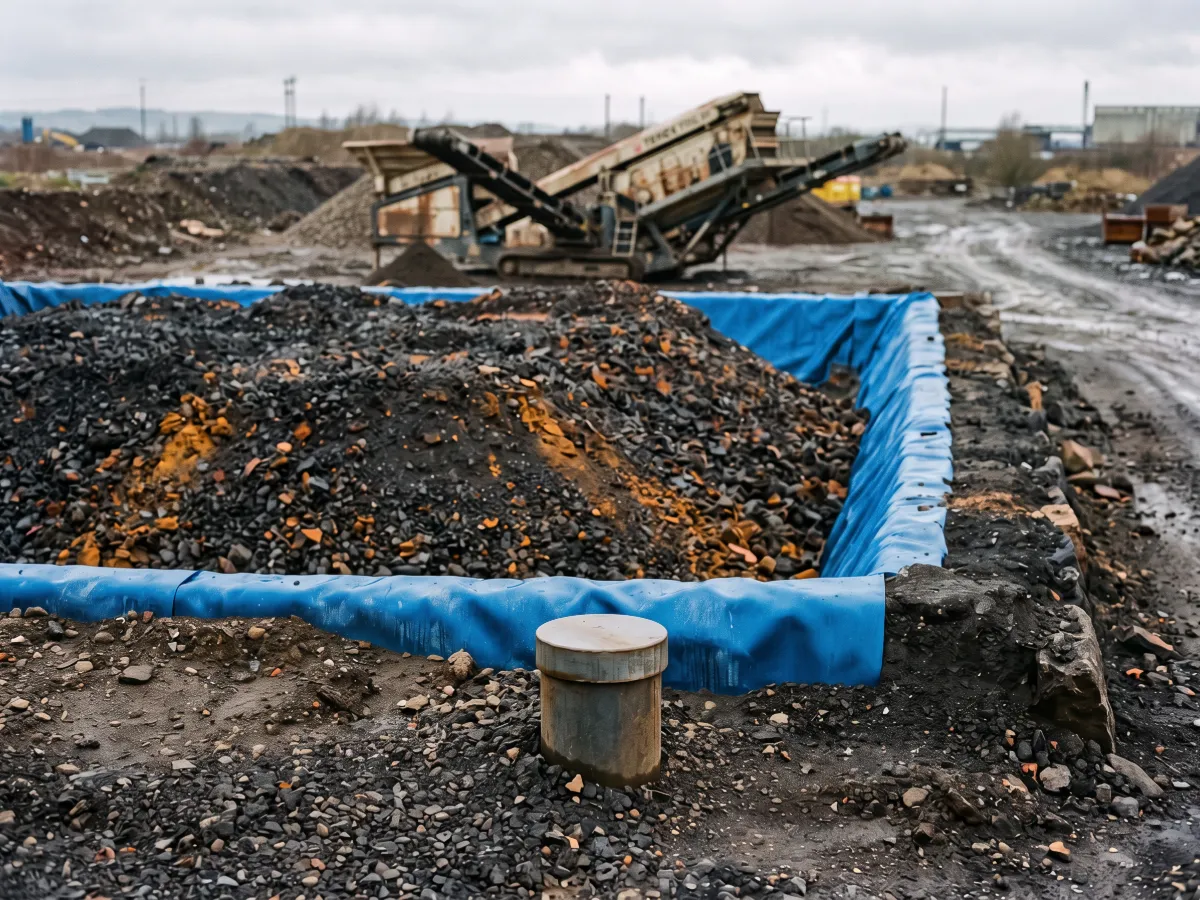
Excavated dark fill material placed within a lined cell

Concentrations, exposure and intended land use

The assessment needs to consider how a substance could reach a person, water or another receptor. Total concentration is one part of that picture. The substance's form and mobility, site conditions and the proposed use of the land can affect the interpretation.
There is no single universal 'safe metals level' for every site and purpose. Human-health assessment, environmental assessment and waste classification answer different questions; one result should not be used interchangeably across all three.

Managing metal-contaminated soil

Suitable options may include targeted excavation, a designed cover system, containment or an appropriate treatment process. The choice needs to follow the risk assessment and account for the site's intended use and required approvals. Metals cannot simply be treated as though they will biodegrade like some organic contaminants; any proposed process needs a clear explanation of how it reduces the relevant risk.

Waste classification and records

Soil leaving site as waste needs an appropriate description and classification, an authorised route and the correct movement records. Do not dilute affected material by mixing it with cleaner soil to avoid the proper assessment or controls.
The verification evidence should show how the completed works meet the agreed objectives, rather than relying on the ground looking clean after excavation.
Related
Land remediation service →Asbestos in soil →Hydrocarbon-contaminated soil →
FURTHER READING
Environment Agency — LCRM Stage 1 risk assessment ↗Waste classification technical guidance WM3 (GOV.UK) ↗

Discuss industrial made ground

Contact our team with the site location, previous use, investigation reports and the groundworks you are planning. We can discuss the information needed to define the remediation work.
DISCUSS YOUR SITE
QUESTIONS

Questions about metals in soil

Does ash or clinker always mean the soil is hazardous?
No. These materials help inform the investigation, but hazardous-waste classification requires assessment of the actual waste.
Can a soil test tell us whether housing is suitable?
Laboratory data informs the assessment. A competent interpretation must consider the development proposal, site conditions and relevant exposure pathways; a laboratory certificate alone is not planning approval.

Not sure which
service you need?

Send a photo for initial advice
ASK US or call 0333 335 6375
CONTACT US

Talk to a specialist today

CALL US NOW
0333 335 6375
Mon to Fri 8am to 6pm · Emergencies day & night
Tap to call →
EMAIL US
info@innov8-group.co.uk
Attach photos for a faster quote
Send an email →
CALL BACK
We ring you back the same working day
Leave your number, we do the chasing
Arrange a call →
QUOTATION FORM
Quotation usually within 24 hours for straightforward enquiries
Send the details and photos
Start your quote →
Innov8 Group
HSE-licensed asbestos removal and environmental contractor. Surveys, removal, demolition, remediation and hazardous waste — one team, one responsibility. North West based, working UK-wide.
Follow us on social media
PAGES
About usServicesCostsProjectsNewsLocationsAccreditationsFAQsSurvey analyserContact
SECTORS
HomeownersLandlordsHousing associationsSchoolsHealthcareMain contractorsIndustrialRetail & officesPublic sectorDevelopers & land remediation
CONTACT
0333 335 6375 info@innov8-group.co.uk Unit 7, Wilsons Business Park Centre, Manchester M40 8WN
website by pixelmonster
5-star rated by our customers
5-star rated on Trustpilot reviews
5-star rated on Yell business reviews
Verified reviews across the web
Trustindex© 2026 Innov8 UK Group Ltd. All rights reserved. Privacy Cookies
website by pixelmonster