info@innov8-group.co.uk Ring us: 0333 335 6375
Not sure which service you need? Ask us
REQUEST A CALL BACK
innov8 Group
01About 02Services 03Costs 04Projects 05News 06Locations 07Contact INSTANT QUOTE
GUIDES · CONTAMINATED LAND

Hydrocarbon-Contaminated Soil: Testing and Remediation Options.

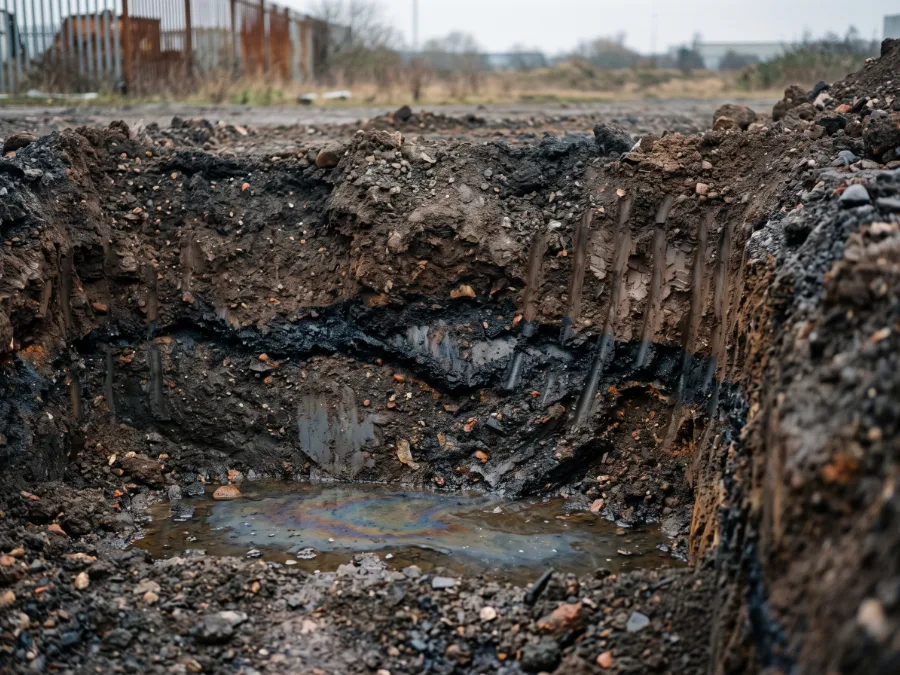
Hydrocarbon-contaminated soil can be associated with fuel storage, leaking tanks, vehicle maintenance and historic industrial activity. Oil staining, odours or a sheen on water may justify investigation, but appearance alone cannot establish the substance, concentration or extent of contamination.
Dark-stained soil in the face of a trial pit with a sheen on standing water

What are hydrocarbons in soil?

Petroleum products such as diesel, petrol and oils contain mixtures of hydrocarbons. Their behaviour varies: some components may give rise to vapour concerns, while others may persist in soil or affect water. The assessment needs to consider the likely product, site conditions and potential routes of exposure, rather than treating every oil stain as the same problem.

Investigating oil and diesel contamination

A review of previous site use, fuel tanks, drainage and earlier reports helps define the investigation. Sampling should test the suspected source area and address the possible spread of contamination. Groundwater or vapour investigation may be needed where the conceptual site model identifies a relevant pathway.
For chemical assessment, laboratories may analyse total petroleum hydrocarbons (TPH), individual compounds or appropriate hydrocarbon fractions. The test suite should reflect the suspected source and the purpose of the assessment; a single TPH number is not a complete remediation specification.

What do the laboratory results mean?

Results should be interpreted against the proposed use of the land and the people, water or other receptors that could be affected. A value used to assess residential exposure is not automatically a waste-disposal threshold. Similarly, an acceptable result for one sampled location does not establish the condition of the entire site.

Hydrocarbon remediation options

The investigation informs an options appraisal. Depending on the contamination and site conditions, suitable approaches may include removing affected soil or using an appropriate treatment process. The selected method must address the identified risks, practical constraints and regulatory requirements. Not every fuel-contaminated site needs wholesale excavation, and no treatment should be promised before the assessment supports it.
Where historic industrial fill is also present, read about heavy metals in soil and made ground. Buried tar requires its own assessment: see our coal tar and bitumen guide.

Soil disposal and completion records

If soil will leave site as waste, its classification and the receiving facility's requirements must be established before transport. Waste acceptance criteria (WAC) testing is not a substitute for waste classification. The completed works should be documented against the remediation objectives, including verification and any further monitoring required.
Related
Land remediation service →Heavy metals in soil →Tar and bitumen waste →
FURTHER READING
Environment Agency — LCRM Stage 1 risk assessment ↗Classify different types of waste (GOV.UK) ↗

Discuss your site

Send us your site information, including the location, known fuel-storage history, reports and planned development. We will review the information provided and discuss the next step.
DISCUSS YOUR SITE
QUESTIONS

Questions about hydrocarbon-contaminated soil

Does an oily sheen prove there is a fuel leak?
No. It is an observation that needs interpretation alongside site history and appropriate investigation. A photograph cannot determine the contaminant or its concentration.
Is all oil-contaminated soil hazardous waste?
Do not assume either classification. When material is waste, its composition and hazardous properties need assessment using the applicable classification guidance.
What affects remediation cost?
The extent and depth of contamination, access, water conditions, the required outcome and available treatment or disposal routes all influence the scope. A quotation needs the investigation information and proposed works.

Not sure which
service you need?

Send a photo for initial advice
ASK US or call 0333 335 6375
CONTACT US

Talk to a specialist today

CALL US NOW
0333 335 6375
Mon to Fri 8am to 6pm · Emergencies day & night
Tap to call →
EMAIL US
info@innov8-group.co.uk
Attach photos for a faster quote
Send an email →
CALL BACK
We ring you back the same working day
Leave your number, we do the chasing
Arrange a call →
QUOTATION FORM
Quotation usually within 24 hours for straightforward enquiries
Send the details and photos
Start your quote →
Innov8 Group
HSE-licensed asbestos removal and environmental contractor. Surveys, removal, demolition, remediation and hazardous waste — one team, one responsibility. North West based, working UK-wide.
Follow us on social media
PAGES
About usServicesCostsProjectsNewsLocationsAccreditationsFAQsSurvey analyserContact
SECTORS
HomeownersLandlordsHousing associationsSchoolsHealthcareMain contractorsIndustrialRetail & officesPublic sectorDevelopers & land remediation
CONTACT
0333 335 6375 info@innov8-group.co.uk Unit 7, Wilsons Business Park Centre, Manchester M40 8WN
website by pixelmonster
5-star rated by our customers
5-star rated on Trustpilot reviews
5-star rated on Yell business reviews
Verified reviews across the web
Trustindex© 2026 Innov8 UK Group Ltd. All rights reserved. Privacy Cookies
website by pixelmonster