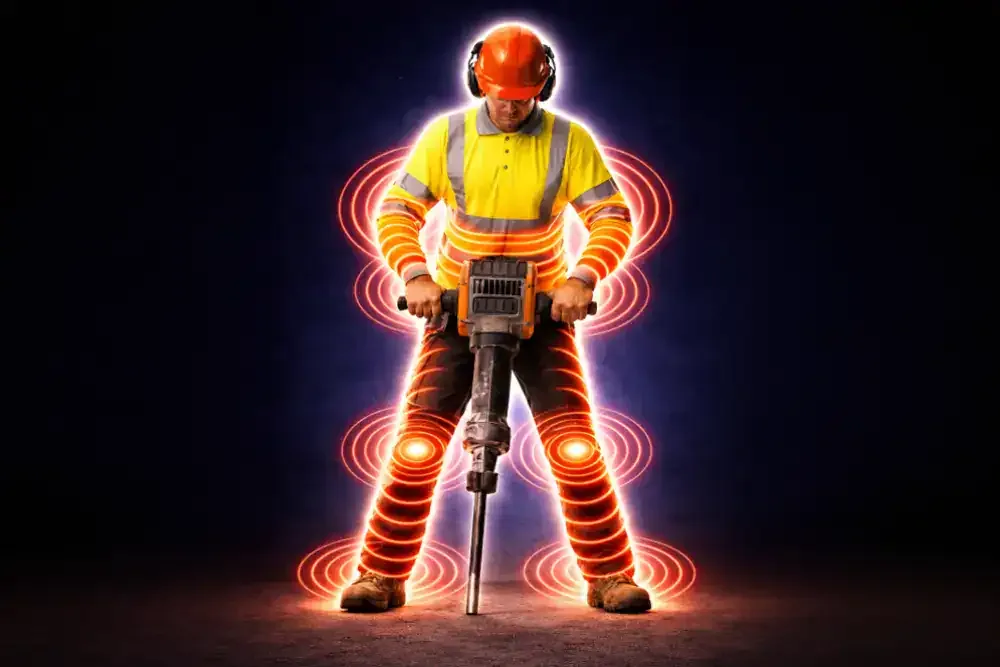
A licensed asbestos contractor's duty of care does not stop at fibre control. Building an enclosure and removing asbestos involves hand tools, and that brings its own health risk: hand-arm vibration syndrome (HAVS). In August 2025, an HSE inspector visiting an Innov8 UK Group project near Garstang gave constructive feedback on our approach to vibration — and we used it to sharpen our systems.
Importantly, the inspector identified no material breach; tool use on the job was low and mostly associated with building the enclosure itself. But good advice is worth acting on regardless. We reviewed our HAVS risk assessment to make exposure estimates as accurate as possible, strengthened trigger-time monitoring so that operative exposure stays comfortably below the exposure action value, and reviewed our health surveillance programme to ensure it fully meets statutory requirements.
We also reinforced awareness among supervisors and operatives — including the real limitations of anti-vibration gloves — and improved our record-keeping so that HAVS records and monthly checks are held on site as well as centrally. HSE resources such as the HAVS calculator and INDG175 guidance support this ongoing work.
HAVS is a serious, irreversible condition caused by regular exposure to vibration from power tools. Because asbestos removal happens inside sealed enclosures with operatives in full RPE, it is easy to focus only on fibre control and overlook other hazards. A genuinely competent contractor manages the whole risk picture — vibration, noise, working at height, manual handling and confined spaces — not just the asbestos.
The project near Garstang — the licensed removal of external AIB soffit from an occupied home — was delivered safely and to standard. But the lasting value was in what we learned. Welcoming HSE feedback, acting on it quickly, and building it into better systems is how Innov8 UK Group protects the people who do this demanding work, day in, day out.